Japonya Mobil Altyapısı: Teknik Bir Bakış
Japan's telecommunications infrastructure is among the most advanced globally, a fact readily apparent to any engineer. The country has been a pioneer in mobile technology, from 3G to 5G, consistently pushing the boundaries of network performance. When you arrive, you'll primarily connect to networks leveraging FDD-LTE on bands B1 (2100 MHz) and B3 (1800 MHz) for 4G, with significant deployments of TDD-LTE on B42 (3.5 GHz) in urban areas. For 5G, expect to see robust coverage on sub-6 GHz bands like n77 (3.7 GHz) and n78 (3.5 GHz), along with mmWave deployments on n257 (28 GHz) in dense urban hotspots like Shibuya Crossing or Tokyo Station. This intricate blend ensures high capacity and low latency, crucial for supporting Japan's data-hungry populace and its many visitors.
Understanding these frequency bands is not merely academic, it directly impacts your device's performance. For instance, if your phone lacks support for B42 or n78, you might find your peak speeds limited, especially during congested times. Japanese carriers are adept at carrier aggregation, combining multiple frequency blocks to boost bandwidth, so a device capable of 4x4 MIMO and at least 3-band aggregation will generally outperform one with more basic RF capabilities. This is particularly noticeable when downloading large files or streaming 4K video on the Shinkansen, where network handoffs occur at high speeds.

Japonya'da 5G Kapsamı ve Hız Beklentileri
Japan's 5G rollout has been strategic, prioritizing high-traffic areas. Major cities like Tokyo, Osaka, and Nagoya have extensive 5G coverage, particularly around transport hubs, commercial districts, and popular tourist sites. Rural areas, as is common globally, still rely heavily on 4G LTE, but with excellent backhaul infrastructure. When we talk about speeds, it's essential to set realistic expectations. While theoretical peak speeds can exceed 1 Gbps on 5G, typical real-world speeds in Tokyo for a sub-6 GHz 5G connection range from 200-500 Mbps download and 30-80 Mbps upload. On 4G LTE, you're looking at averages of 50-150 Mbps download and 10-30 Mbps upload. These figures are more than sufficient for navigation, video calls, and social media, even for simultaneous use.
It's worth noting that network congestion, especially during peak hours in areas like Akihabara or during major events, can cause temporary dips. However, the overall resilience of the Japanese network, thanks to extensive fiber deployment and dense cell site placement, means significant slowdowns are rare. You can generally rely on the advertised speeds from the major carriers, though a buffer is always wise. (And remember, these are averages, not guarantees.)
Neden Japonya Seyahatiniz İçin Bir eSIM Seçmelisiniz?
The traditional method of buying a local physical SIM card in Japan involves a few hurdles. You often need to present your passport, fill out forms, and sometimes navigate language barriers at an airport kiosk or electronics store. An eSIM simplifies this entirely. It's a digital SIM profile downloaded directly to your phone, meaning you can activate your data plan before you even leave home, or while waiting for your luggage at Narita (NRT) or Haneda (HND) Airport.
Beyond convenience, eSIMs offer flexibility. You can maintain your primary SIM card for calls and texts from your home country, using the eSIM solely for data. This dual-SIM functionality is incredibly practical for travelers who need to stay reachable on their usual number but want to avoid roaming data costs. It's a setup I personally use on every international trip, from the bustling markets of Central Asia to the quiet trails of a national park.
| Feature | eSIM | Physical SIM (Local) | International Roaming |
|---|---|---|---|
| Activation Time | Minutes (remote) | Hours (in-person) | Instant (but costly) |
| Cost Efficiency (Data) | High | High | Low |
| Convenience | Very High | Moderate | High |
| Number Portability | Retain primary | New local number | Retain primary |
| Physical Handling | None | Required | None |
| Environmental Impact | Minimal (no plastic) | Moderate (plastic card) | Minimal |
eSIM'in Seyahat Planlarınızı Nasıl Basitlestirdiği
Imagine landing in Tokyo, clearing customs, and instantly having data to call a taxi, navigate the intricate subway system, or look up the best ramen joint in Shibuya. This immediate connectivity is where an eSIM truly shines. There's no searching for a SIM vending machine, no fiddling with a tiny ejector tool, and no worries about losing your home SIM card. For an engineer, it's about reducing points of failure and optimizing the user experience from the outset.
This ease of use extends beyond arrival. If your plans suddenly take you from Tokyo to Hokkaido, your eSIM plan travels with you, leveraging the same robust national network. There's no need to consider regional SIM options or coverage gaps. It's a single, cohesive solution that works across the entire country, a stark contrast to some multi-country SIMs that might perform unevenly as you cross borders, for example, on a Central Asia trip.
Japonya İçin Bir eSIM Nasıl Alınır ve Kurulur?
Acquiring and activating an eSIM for your Japan trip is a straightforward process, designed for efficiency. Here's a general outline, though specific steps might vary slightly depending on your eSIM provider. The key is to do this when you have a stable internet connection, ideally before you depart.
Adım Adım eSIM Aktivasyon Rehberi
- Choose Your Plan: Visit a reputable eSIM provider's website, such as the Japan eSIM page, and select a data package that suits your travel duration and data needs. You'll find options ranging from a few gigabytes for a short trip to unlimited data for longer stays.
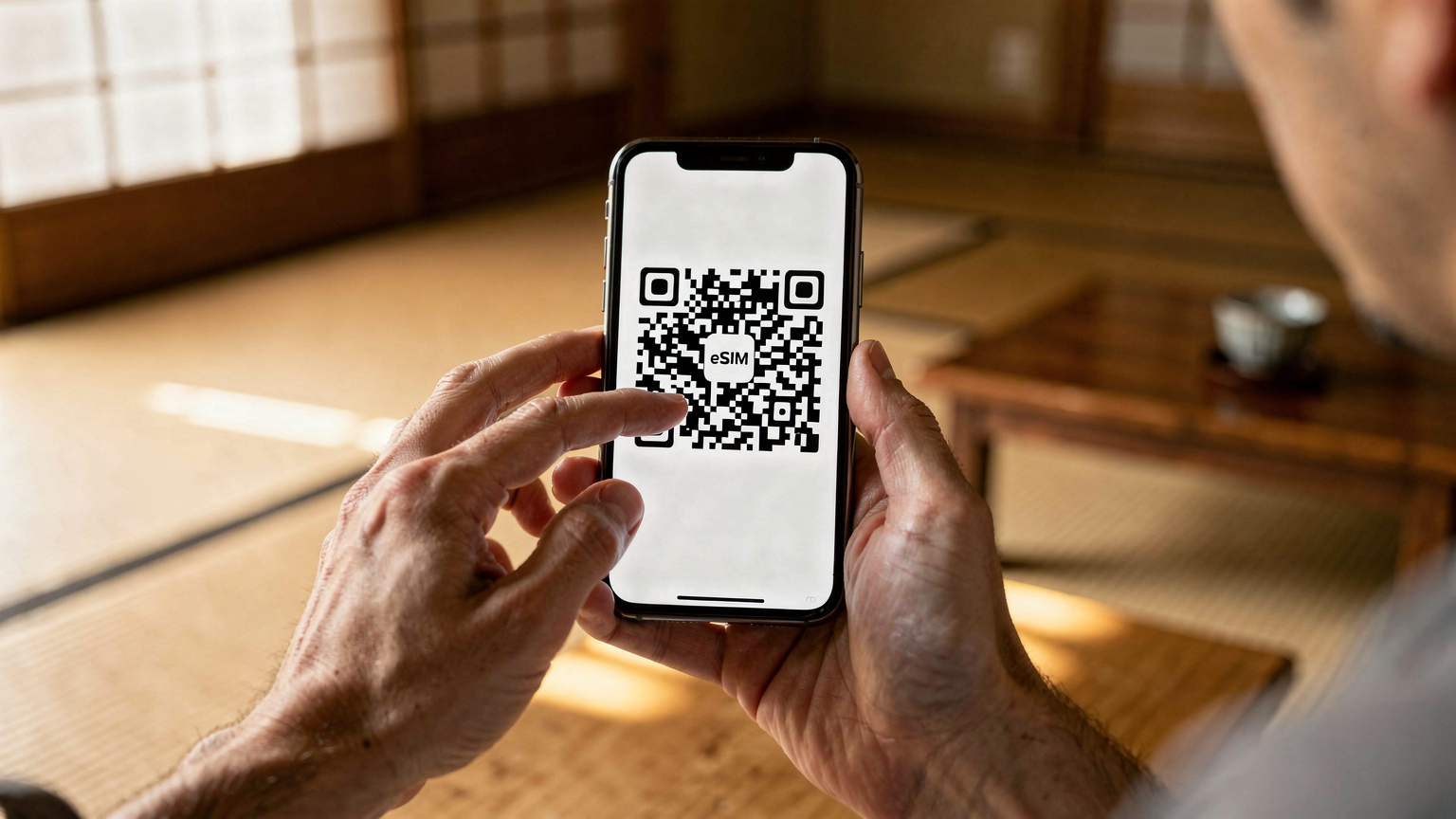
- Purchase and Receive QR Code: Complete the purchase. You will typically receive an email containing a QR code or manual activation details. This QR code is your digital SIM profile. Keep it safe.
- Scan and Activate: On your eSIM-compatible smartphone (ensure yours is, especially if it's an older model or region-locked), go to Settings > Cellular/Mobile Data > Add eSIM. Scan the QR code. Your phone will then download and install the eSIM profile. For detailed steps specific to Apple devices, you might refer to an iPhone eSIM activation guide.
- Configure Settings: Once installed, you'll need to name your new eSIM (e.g., "Japan Travel"), set it as your primary line for cellular data, and ensure data roaming is enabled for this profile. You may also need to disable your physical SIM's data roaming to prevent unintended charges.
- APN Settings Check: Most eSIMs auto-configure the Access Point Name (APN). However, in rare cases, especially with certain Android devices or specific older iPhone models (pre-iPhone XS), you might need to manually enter the APN. This information is always provided by your eSIM provider. For Japan, common APNs are often simply "internet" or carrier-specific ones, but always defer to the provider's instructions.
Hangi Cihazlar eSIM'i Destekler?
eSIM compatibility has become widespread, particularly among newer smartphone models. Generally, iPhones from the XS/XR series onwards, most Samsung Galaxy S and Note series devices from the S20/Note20 onwards, and Google Pixel phones from the Pixel 3 onwards support eSIM functionality. However, it's crucial to verify your specific device model, as regional variations exist. For example, some devices sold in mainland China do not support eSIMs. Always check your phone's specifications or consult your device manufacturer's website before purchasing an eSIM.
Pro TipBefore leaving home, download any necessary apps you'll need in Japan, such as Google Maps (with offline maps), Japan Transit Planner (Jorudan or Navitime), and translation tools. Having these ready on Wi-Fi saves valuable data when you land.
eSIM ile Japonya'da Arama Yapmak: VoLTE ve VoWiFi Gerçekleri
While an eSIM primarily provides data, the ability to make and receive calls is still critical. This is where technologies like Voice over LTE (VoLTE) and Voice over Wi-Fi (VoWiFi) come into play. Many international eSIMs are data-only, meaning they don't provide a local Japanese phone number for traditional voice calls. However, this doesn't leave you stranded.
For voice communication, you have a few robust options. Over-the-top (OTT) applications like WhatsApp, Signal, Telegram, and FaceTime (for Apple users) work seamlessly over your eSIM data connection. These apps allow you to make voice and video calls to anyone, anywhere, often with superior audio quality compared to traditional cellular calls, provided both parties have a stable internet connection. This is generally the most practical approach for travelers.
VoLTE ve VoWiFi Desteği Ne Anlama Geliyor?
VoLTE, or Voice over LTE, routes voice calls over the 4G LTE data network rather than the older 2G/3G circuits. This results in clearer calls and allows you to use data simultaneously during a call. VoWiFi, or Voice over Wi-Fi, allows you to make and receive calls using a Wi-Fi connection, which is particularly useful in areas with poor cellular reception (like deep inside a Tokyo subway station) or to save on cellular minutes. The catch for travelers using an eSIM, however, is that these features are typically enabled by your *home* carrier on your *primary* SIM. If your eSIM is data-only, it won't support VoLTE or VoWiFi directly.
Therefore, if you need to make traditional phone calls to Japanese landlines or local mobile numbers, and don't want to rely on internet-based apps, consider using a voice-over-IP (VoIP) service like Skype or Google Voice, which can be topped up with credit to make calls to regular phone numbers at very low rates. Alternatively, if your home SIM supports international roaming with VoLTE/VoWiFi and you're willing to pay per-minute rates (which can be steep, sometimes exceeding €1.50 per minute), you can keep your home SIM active for calls and use the eSIM for data. This hybrid approach offers the best of both worlds, though careful monitoring of call costs is essential.
Japonya'daki Ana Operatörler ve Kapsam Detayları
Japan's mobile market is dominated by three major players: NTT Docomo, au (KDDI), and SoftBank. Rakuten Mobile is a newer entrant, rapidly expanding its network. Each has its strengths, but all generally offer excellent coverage, especially in metropolitan areas. When you purchase an eSIM for Japan, it will almost certainly operate on the network of one of these established carriers. Understanding their respective networks helps manage expectations.
NTT Docomo: Often considered the network with the widest and most robust coverage, especially in rural areas and mountainous regions. Their 5G network leverages n78 and n77 predominantly, with good penetration. Docomo's 4G LTE network is dense, utilizing B1, B3, B19 (800 MHz), and B21 (1500 MHz), with B19 being crucial for wider rural coverage. Speeds are consistently high.
au (KDDI): Known for strong performance in urban centers and a good balance of urban/rural coverage. au uses B1, B18/26 (800 MHz), and B41 (2.5 GHz TDD-LTE) for 4G, and n77/n78 for 5G. Their network is well-regarded for stability and speed, particularly in high-traffic zones. (As a side note, B18/26 is shared with some rural deployments, offering decent reach.)
SoftBank: Offers excellent speeds and coverage in urban and suburban areas, often favored for its network performance in dense city environments like Tokyo. SoftBank's 4G LTE network uses B1, B3, B8 (900 MHz), and B41. For 5G, they also rely on n77/n78. Their network is known for rapid deployment of new technologies and competitive speeds.
| Carrier | Primary 4G Bands | Primary 5G Bands (Sub-6 GHz) | Typical Urban DL Speeds (Mbps) | Typical Urban UL Speeds (Mbps) |
|---|---|---|---|---|
| NTT Docomo | B1, B3, B19, B21 | n77, n78 | 100-450 | 20-70 |
| au (KDDI) | B1, B18/26, B41 | n77, n78 | 90-400 | 18-65 |
| SoftBank | B1, B3, B8, B41 | n77, n78 | 80-380 | 15-60 |
| Rakuten Mobile | B3 | n77 | 50-200 | 10-40 |
eSIM'iniz Hangi Operatörü Kullanacak?
Most global eSIM providers partner with one or more of these major Japanese carriers to offer service. While the specific carrier isn't always explicitly stated at the time of purchase, the provider's coverage maps or FAQs often offer clues. For optimal performance, especially if you're traveling beyond major cities, choosing an eSIM that leverages NTT Docomo's network is often a safe bet due to its extensive reach. However, for a Tokyo-centric trip, any of the top three will provide excellent service.
One common technical detail to be aware of: many eSIM providers utilize Carrier-Grade Network Address Translation (CGNAT) or IPv6-only network setups. This isn't usually an issue for general web browsing, messaging, or streaming. However, if you rely on specific applications requiring a public IPv4 address or direct peer-to-peer connections (e.g., some VPN configurations, specific gaming servers, or certain IoT devices), you might encounter limitations. Always check with your eSIM provider if you have such niche requirements.
Fiyatlandırma ve Veri Paketleri: Hangisi Sizin İçin Uygun?
When selecting an eSIM plan, pricing and data allowances are paramount. The market for Japan eSIMs is competitive, offering a range of options to suit different travel styles and budgets. You'll typically find plans structured by data volume (e.g., 5 GB, 10 GB, 20 GB) or by unlimited data for a fixed duration (e.g., 7 days, 15 days, 30 days).
For a typical tourist spending a week in Tokyo and perhaps a few days in Kyoto, 10-20 GB of data is usually ample. This allows for frequent use of navigation apps (like Google Maps or Apple Maps, which are essential for Tokyo's complex streets), social media, light streaming, and keeping in touch with family. If you plan on heavy video streaming, large file uploads, or using your phone as a hotspot for multiple devices, an unlimited data plan might be more suitable.
| Plan Type | Duration | Data Allowance | Estimated Cost (USD) | Best For |
|---|---|---|---|---|
| Standard Data | 7 Days | 5 GB | ~10-15 | Light users, short trips |
| Mid-Tier Data | 15 Days | 10-20 GB | ~20-35 | Average users, longer trips |
| Unlimited Data | 7-30 Days | Unlimited* | ~25-60 | Heavy users, hotspot, remote work |
| Multi-Country (Asia) | 30 Days | 10 GB | ~40-55 | Regional hopping (e.g., Japan, S. Korea, Taiwan) |
*Note: "Unlimited" plans often come with a Fair Usage Policy (FUP), meaning speeds might be throttled after a certain threshold (e.g., 2 GB/day) to prevent network abuse. Always read the fine print.
Yerel SIM Kartlarına Karşı eSIM: Maliyet Analizi
Compared to purchasing a physical SIM card locally, eSIMs generally offer competitive pricing, especially for short to medium-term travel. Local SIM cards in Japan, particularly tourist-focused ones, can sometimes be more expensive for similar data allowances, and their activation process often takes more time. Roaming from your home carrier, as previously mentioned, is almost always the most expensive option, with costs easily reaching €15 per day, which makes a dedicated eSIM plan a clear winner for value.
Consider also the hidden costs of physical SIMs: the time spent finding a store, potential transportation to get there, and the mental overhead of dealing with a foreign language if you're not fluent. An eSIM eliminates these, making the slight price difference (if any) well worth it for the convenience and peace of mind. For example, a similar plan for Greece with Cosmote eSIM also shows significant savings over traditional roaming.
Tokyo'da Bağlantıyı Maksimuma Çıkarma İpuçları
Tokyo is a sprawling metropolis, and while its network infrastructure is exceptional, there are still strategies to ensure you get the best possible connection throughout your trip. From navigating the subway to finding the fastest Wi-Fi, a little planning goes a long way.
Toplu Taşıma ve Yeraltı Ağ Kapsamı
Tokyo's subway system is legendary for its efficiency, but like many underground networks, cellular coverage can be spotty in older tunnels. However, most major lines, especially the Yamanote Line and newer subway extensions, now boast excellent 4G and even 5G coverage throughout their stations and even within moving trains. This wasn't always the case, and it's a testament to the continuous investment in infrastructure. You can generally expect to maintain connectivity while commuting between areas like Shinjuku, Shibuya, and Ueno. For longer journeys on the Shinkansen (bullet train), coverage is also generally good, though tunnels can still create brief drops. This is where pre-downloaded content or offline maps come in handy.
Kamusal Wi-Fi ve Sıcak Noktalar
While your eSIM will be your primary data source, don't underestimate the utility of public Wi-Fi. Tokyo has numerous free Wi-Fi hotspots, especially in major train stations (e.g., JR East Free Wi-Fi), airports, convenience stores (like 7-Eleven, FamilyMart, Lawson), cafes, and hotels. Look for signs with the "Japan Free Wi-Fi" logo. These can be useful for saving your eSIM data, especially if you're engaging in data-intensive activities like large app updates or cloud backups. Remember, public Wi-Fi networks can be less secure, so always use a VPN if you're handling sensitive information.
eSIM ile Tokyo'da Gezinmek ve Daha Fazlası
An eSIM is more than just internet access, it's a gateway to experiencing Tokyo like a local. From navigating complex train lines to ordering food, seamless connectivity enhances every aspect of your journey.
Navigasyon ve Yerel Ulaşım Uygulamaları
Tokyo's public transportation network is incredibly efficient but can be daunting. Apps like Japan Transit Planner (Jorudan or Navitime) are indispensable. With real-time data from your eSIM, you can get exact train times, platform numbers, and even alternative routes if there are delays. Google Maps is also highly effective for walking directions and locating points of interest. Having a reliable data connection means you can check these apps on the go, making spontaneous detours or last-minute itinerary changes a breeze. Imagine confidently navigating from a ramen shop in Shinjuku Golden Gai to a late-night karaoke session without a moment's hesitation.
Dijital Ödemeler ve Çevrimiçi Rezervasyonlar
Japan is increasingly embracing digital payments, and having a stable data connection is key. Many shops, restaurants, and attractions accept mobile payment services like Apple Pay, Google Pay, or local options like PayPay and Line Pay. For popular restaurants or cultural experiences, online reservations are often required, especially for places with limited seating. Your eSIM ensures you can make these bookings promptly and confirm details while you're out exploring. This is a far cry from the days of needing a local phone number just to make a reservation.
eSIM ile Karşılaşabileceğiniz Olası Sorunlar ve Çözümleri
While eSIMs offer a smooth experience, occasional technical hiccups can occur. As a telecom engineer, I've seen my share of unexpected behaviors. Most issues are easily resolvable with a few troubleshooting steps.
Yaygın eSIM Sorunları ve Giderme İpuçları
- No Service After Activation: First, ensure you've enabled the eSIM profile for cellular data and disabled data roaming for your physical SIM (if applicable). Reboot your phone. If still no service, check your APN settings against what your eSIM provider supplied. Sometimes, a manual network selection (Settings > Cellular/Mobile Data > Network Selection) and choosing one of the major Japanese carriers can help.
- Slow Data Speeds: If speeds are consistently lower than expected, check if you've hit a data cap or a Fair Usage Policy (FUP) throttle. Also, ensure your device is actively connecting to 4G or 5G, not falling back to 3G (which is becoming rare in Japan but can happen in very remote areas). Try toggling Airplane Mode on and off to force a network re-registration.
- Unable to Make Calls: Remember, most travel eSIMs are data-only. If you need voice, use VoIP apps (WhatsApp, FaceTime) over data. If you're trying to use your home SIM for calls, ensure it's active and roaming is enabled on that specific profile.
- eSIM Profile Disappeared: This is very rare but can happen if you factory reset your phone or delete the profile accidentally. Always keep your QR code or activation details safe, as you might need to re-install it.
Teknik Destek ve Yardım İçin Kaynaklar
If you encounter persistent issues, your eSIM provider's customer support is the first point of contact. They can often diagnose problems remotely or provide specific APN settings. Before contacting them, gather relevant information: your phone model, operating system version, the exact error message (if any), and the steps you've already taken. This expedites the troubleshooting process. While some providers offer 24/7 support, response times can vary. It's always a good idea to sort out your eSIM before you're in a critical situation, like needing to call for an emergency.
Tokyo İçin eSIM Satın Almadan Önce Son Kontrol Listesi
Before you finalize your eSIM purchase for Japan, run through this quick checklist to ensure a smooth, connected journey.
- Device Compatibility: Is your smartphone eSIM compatible and unlocked? (Crucial for a Summer Road Trip or any international travel.)
- Data Needs: Have you accurately estimated your data consumption for your trip duration? Factor in navigation, social media, streaming, and any work-related usage.
- Plan Details: Read the fine print: Is it a data-only plan? Does it have a Fair Usage Policy? What is the validity period?
- Activation Method: Do you have access to Wi-Fi to activate the eSIM, and is the QR code or manual activation detail readily available?
- Support Information: Save your eSIM provider's customer support contact information (email, chat link) in case you need assistance while abroad.
- Backup Plan: Have you considered a backup, such as enabling international roaming on your home SIM for emergencies, or noting down locations of free Wi-Fi hotspots?
By taking these steps, you'll be well-prepared to enjoy Japan's incredible sights and sounds, always connected, and ready for whatever adventures Tokyo throws your way. Happy travels, and enjoy the robust networks!
Frequently Asked Questions
Will my existing phone number work with a Japan eSIM?
Yes, your existing phone number on your primary SIM will continue to work for calls and texts. The eSIM provides a separate data connection, allowing you to keep your home number active for communication while using the eSIM for affordable data in Japan.
Can I use an eSIM on multiple devices, like a tablet or another phone?
An eSIM profile is typically tied to a single device. You cannot transfer an activated eSIM profile from one device to another without reactivating it, and most plans do not allow simultaneous use on multiple devices. For multiple devices, you would need separate eSIMs or use one phone as a Wi-Fi hotspot, if your plan permits.
What if my phone is locked to my home carrier?
If your phone is locked to your home carrier, it will not be able to use an eSIM from another provider. You must contact your home carrier and request that they unlock your device before you travel. This is a crucial step for seamless international connectivity.
Are there any hidden fees or charges with Japan eSIMs?
Generally, reputable eSIM providers clearly state all costs upfront. However, be aware of potential data overage charges if you exceed your plan's allowance (for non-unlimited plans) or if you accidentally enable data roaming on your primary SIM. Always check the Fair Usage Policy for "unlimited" plans to understand any speed throttles.
How do I check my data usage with an eSIM in Japan?
You can typically monitor your data usage directly through your phone's settings (Settings > Cellular/Mobile Data), which will show usage for each SIM profile. Additionally, most eSIM providers offer a dashboard or app where you can track your remaining data and manage your plan.
Is 5G available with Japan eSIMs?
Yes, many Japan eSIM plans now offer 5G access where available, leveraging the robust 5G networks of major Japanese carriers like NTT Docomo, au, and SoftBank. Your device must be 5G-compatible and the specific eSIM plan needs to include 5G access for you to benefit from the higher speeds.